

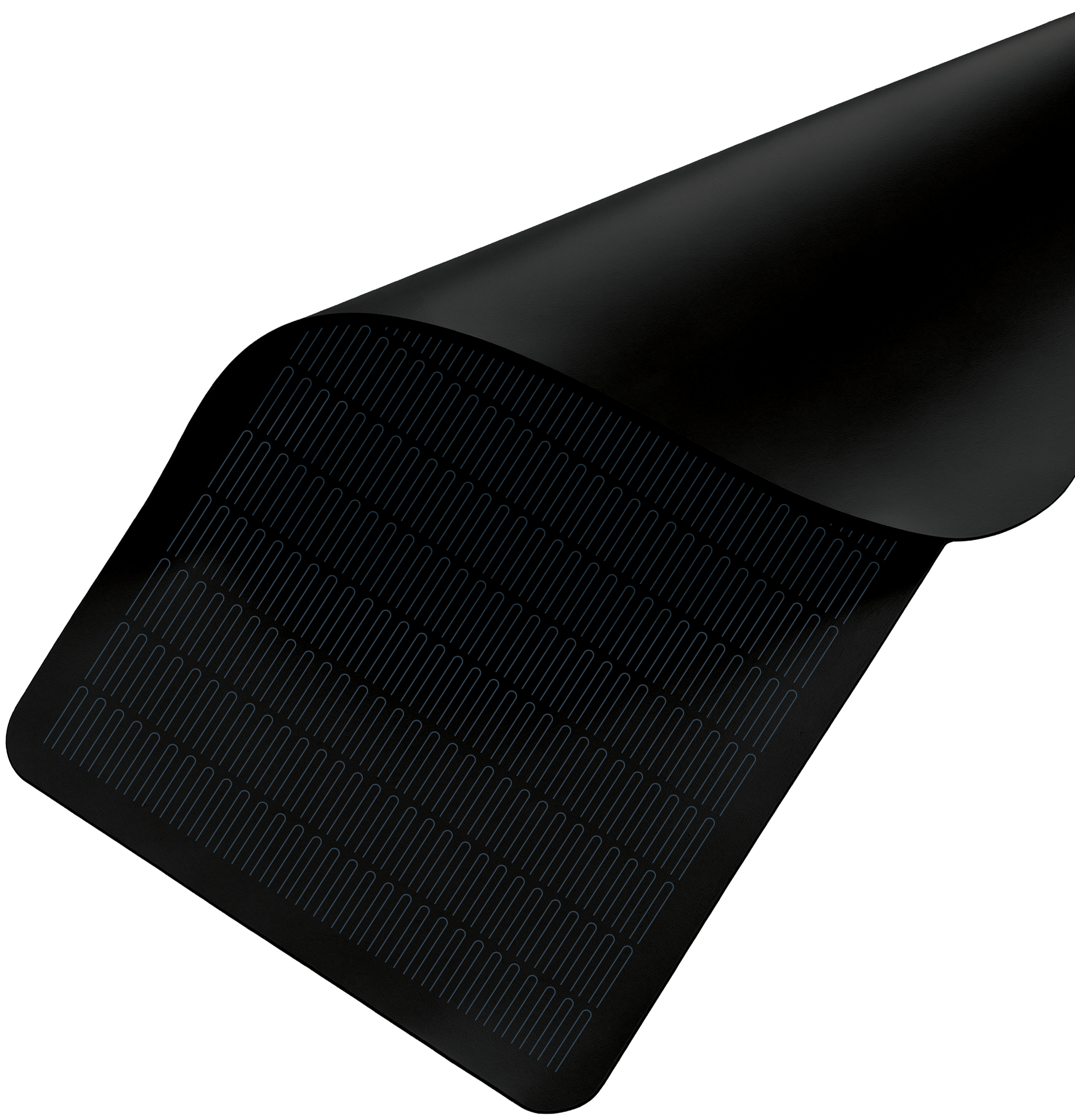

The pinnacle in mobile solar.
ChargeSys ARMORCELL solar panels use CIGS thin-film solar technology and are purpose-built for mobile, marine, and harsh-environment applications. Using the highest grade of engineered materials, ARMORCELL panels are IP68 waterproof, walkable, flexible, vibration proof, hail proof, and rated for extreme temperatures from -40°F to +185°F. Their thin profile allows them to blend in with the lines of your vehicle to maintain the vehicle’s beauty, reduce drag, and eliminate costly object strikes. Flexible enough for curved roofs ARMORCELL panels easily conform to surfaces where glass panels simply can’t.
The ARMORCELL Advantage
Unmatched durability
ETFE top layer withstands hail, foot traffic, extreme heat, and deep cold. No cracking. No delamination. No compromise — rated from -40°F to +185°F.

Superior Shade Performance
CIGS thin-film generates power in overcast, diffuse, and partial-shade conditions where crystalline silicon stalls. More solar harvest, every day.

Built for mobile life
Flexible enough for curved roofs. Sealed to IP68. Low-profile adhesive-mount design fits vehicles, vessels, and trailers where rigid glass panels simply can’t.

Materials matter
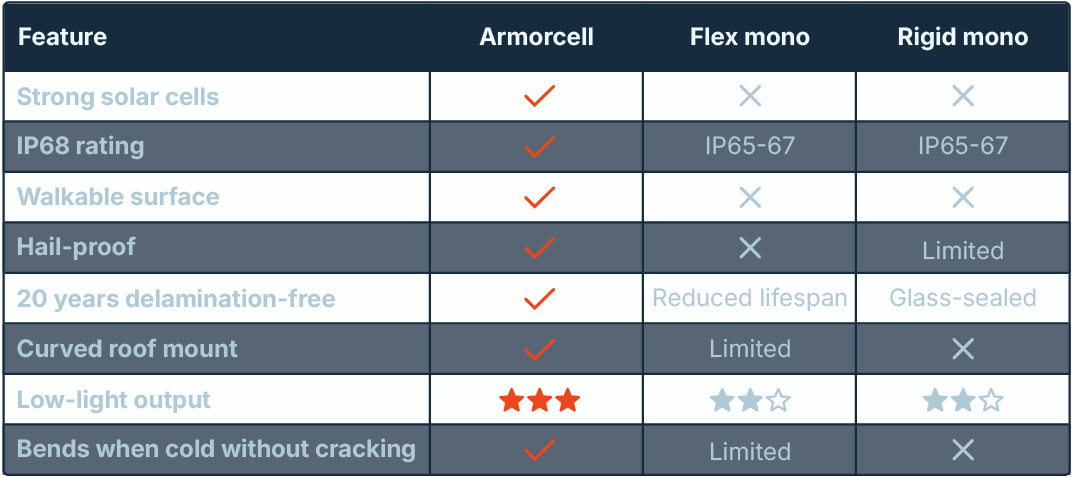
See how ARMORCELL stacks up against flexible and rigid monocrystalline panels.
Top layer armor
ETFE fluoropolymer vs. PET polyester film — why the top layer defines service life.
UV transparent — doesn’t degrade.
ETFE passes UV without absorbing it, maintaining 90%+ light transmission after 20+ years in the field.
Budget panels: UV absorption causes micro-cracking within 3–5 years.
Near-zero moisture permeability.
Protects the adhesive interface, eliminating the hydrolysis that drives delamination.
Budget panels: Moisture permeation causes edge delamination bubbles within 3–5 years of harsh-environment use.
Flexes under impact — doesn’t shatter.
Absorbs IK10 (20J) strikes. Doesn’t shatter, doesn’t cause microcracks like monocrystalline panels. Continues to produce power
Budget panels: Brittle impact response — failing IK07 and below.
-40°F to +185°F operating range.
Matched thermal expansion with CIGS stack — no interfacial stress during thermal cycling.
Budget panels: Thermal cycling fatigues the bond.
Built for every application

Emergency Vehicles
Proven durability & battery health
Ambulances · Fire apparatus · Police vehicles

RV & Van
Silent power & walk-on capable
Curved roofs · Off-grid vehicles

Marine
Saltwater-proof & deck-flush mount
Offshore boats · Cruisers · Liveaboards · Runabouts

Equestrian
Texas heat-proven
Curved roof horse trailers
Estimated service life
In a mobile / harsh environment
ARMORCELL
10-20 years
PET THIN-FILM
3 years
FLEX MONO
5-8 years
PET delamination typically begins at edges within 36 months under harsh environmental conditions. Crystalline panels develop microcracks that propagate with stress and vibration causing premature failure.
Bend profile
Curved roof compatibility

ARMORCELL
5” min radius

FLEX MONO
18" min radius
>30° = microcracks - failure

RIGID MONO
Not Flexible – cracks
ArmorCell's 5" radius fits any curved mobile surface. Flex mono's 18" minimum and 30° bend limit causes microcracks and cell failure on most RV end-caps and horse trailer roofs.
Output vs. panel temperature
% of rated power
100%
95%
90%
85%
80%
95.4
94.2
90.4
88
85.4
81.8
100°F
125°F
150°F
• Armorcell
• Mono perc
At 150°F, ArmorCell retains 85.4% vs. 81.8% for Mono PERC. Coefficients: CIGS −0.36%/°C, Mono PERC −0.45%/°C (STC = 77°F).